Context
The 2026 World Cup is the first one I've watched while living in a host city. I wanted to understand each match as a probability rather than a prediction, and just as much to build something that is honest about how good a hobby model can actually be. Closing market odds, once you strip the bookmaker's margin, encode an enormous amount of information. A spreadsheet does not beat that. So the whole platform is designed around a single discipline: show the model and the market side by side, and label the model as the experimental one.
What I built
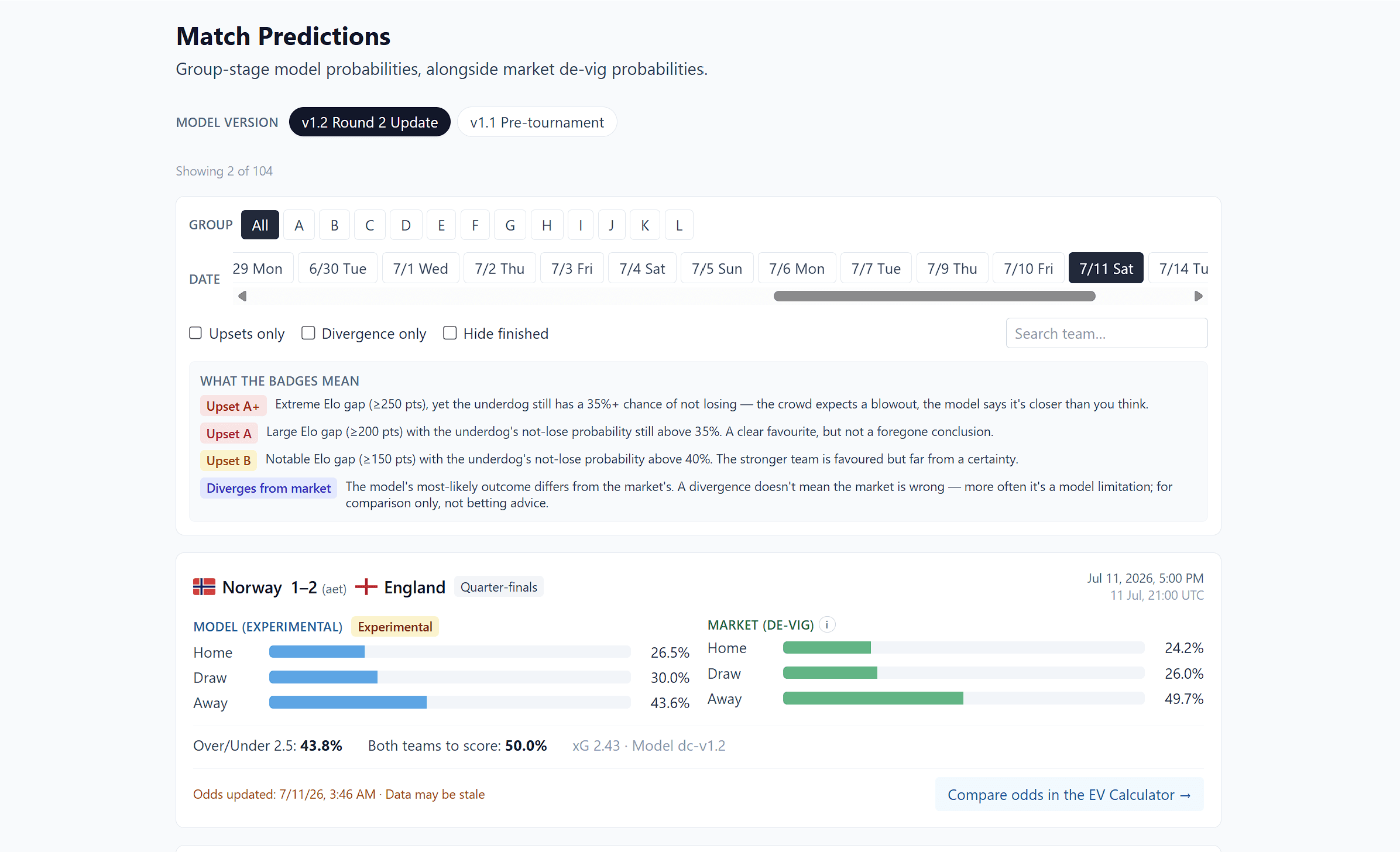
A Python engine turns Elo ratings into expected goals, runs them through a Dixon-Coles scoring model, and produces 1X2, over/under and both-teams-to- score probabilities for every match: all read off the same score-line matrix, and each shown next to the de-vigged market price so the model is never presented as the answer on its own.
On top of the per-match model, a Monte Carlo layer simulates the whole
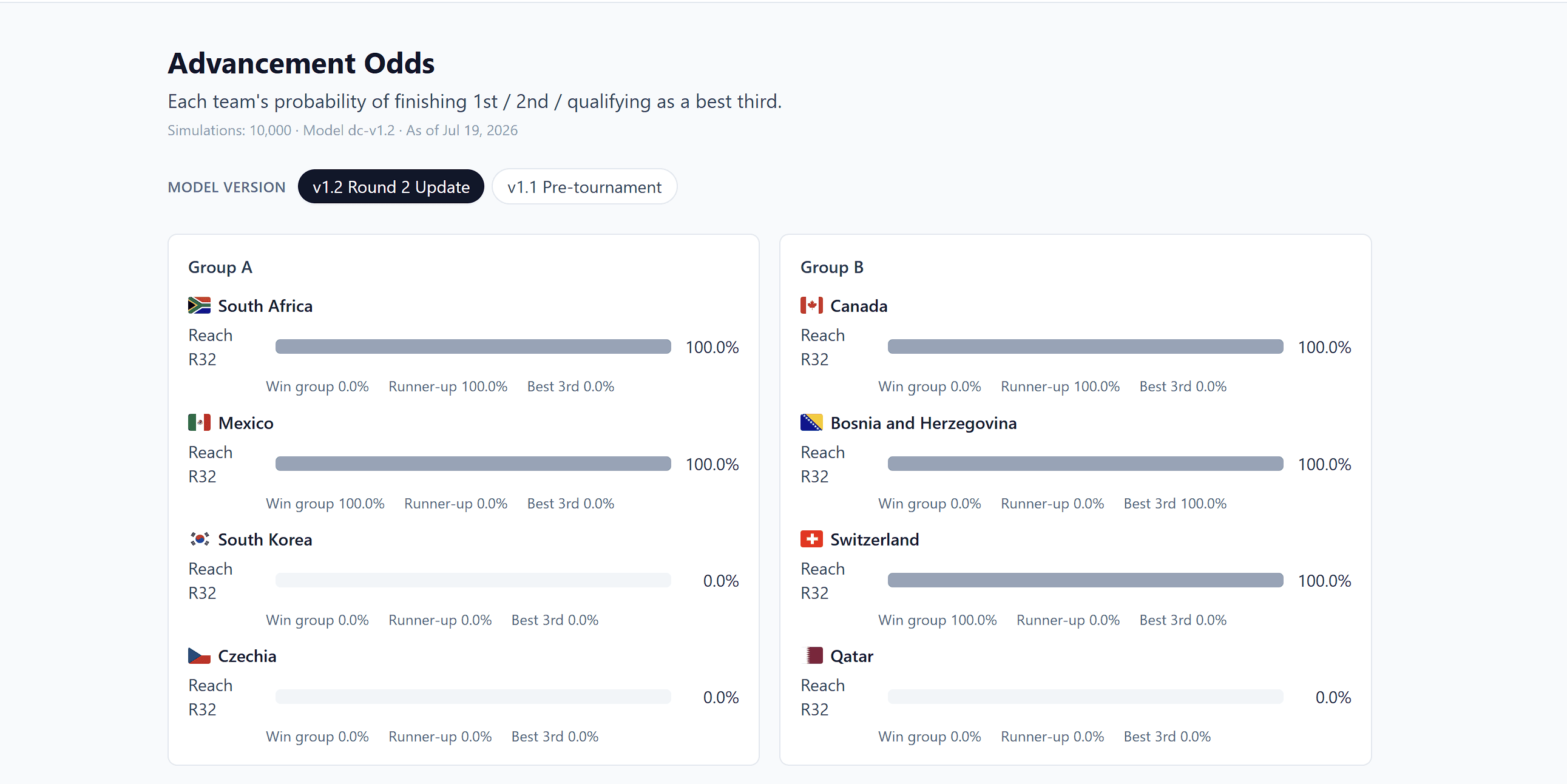
tournament (all 72 group matches, ten thousand times) to produce
advancement and title probabilities under the new 12-groups-of-four
format, where the top two of each group plus the eight best third-placed
teams reach the round of 32. A single-match knockout advance is scored as
the win-expectancy p_home + ½·p_draw, so extra time and penalties fold in
without a separate model.
Elo + fixtures + market odds
eloratings · football-data · Odds API
Dixon-Coles engine
pure-function Python
Monte Carlo (10k sims)
groups + Annex C knockout
Supabase → Next.js
model ∥ de-vigged market
GitHub Actions matchday recompute: ingest → predict → simulate → ingest odds → calibrate
Key decisions & tradeoffs
Market probability is the ground truth; the model is a labeled guest. Every prediction appears beside Pinnacle's de-vigged odds, and the model carries an "experimental" tag everywhere it shows. The alternative (fronting the model as the answer) would have been dishonest and, frankly, wrong more often. The point of the site is a second opinion, not a tip.
Fit the model offline, with no look-ahead leakage. The Dixon-Coles constants were fit on roughly 1,932 international matches since 2010, using only the pre-match Elo snapshot for each game; a version only ships if its validation log-loss beats the previous one. When I then compared v1.0 to the de-vigged market, the model was overconfident in favorites and too low on draws; an independent refit moved in exactly the same direction. Two independent signals agreeing is the reassuring kind of result.
Expected goals come from a log-linear link, and the host lives in the
data model. Elo maps to each team's expected goals through a log-linear
function, not the tempting additive "supremacy" split: that shortcut sends
λ negative when the gap between two teams is large, and a negative Poisson
rate is nonsense. Home advantage is only applied to the three host nations
in their own stadiums, worth roughly an 85-Elo boost. There's a subtle data
trap in that: the fixtures feed lists a host as the away side in some
third-round matches, so I apply a symmetric is_host_away adjustment rather
than swapping the match orientation, which would have desynced the odds and
result ingest that key off the feed's ordering.
Annex C is a validated lookup, not reimplemented logic. In the 2026 format the eight best third-placed teams are seeded into the round of 32 by a FIFA-specified table across C(12,8) = 495 group combinations, rules that are not algorithmically derivable. I scraped that table into a 495-row lookup and hard-validated it (a bijection, no same-group matchups, cross-checked against the bracket's candidate sets). Reimplementing the seeding as logic would have been guesswork; a table you can validate beats code you can't.
Facts and model live on separate code paths. The standings and the qualification-scenario flags (top-two clinched, eliminated, dead rubber, convenience draw) are computed as facts (no model, no calibration) using a deliberately conservative points-band method that can only under-report a clinch, never falsely declare one. The tempting shortcut was to reuse the Monte Carlo ranking, but a simulation forces a full order via tiebreakers and would lie about certainty. A number that reads as fact has to be one.
Results
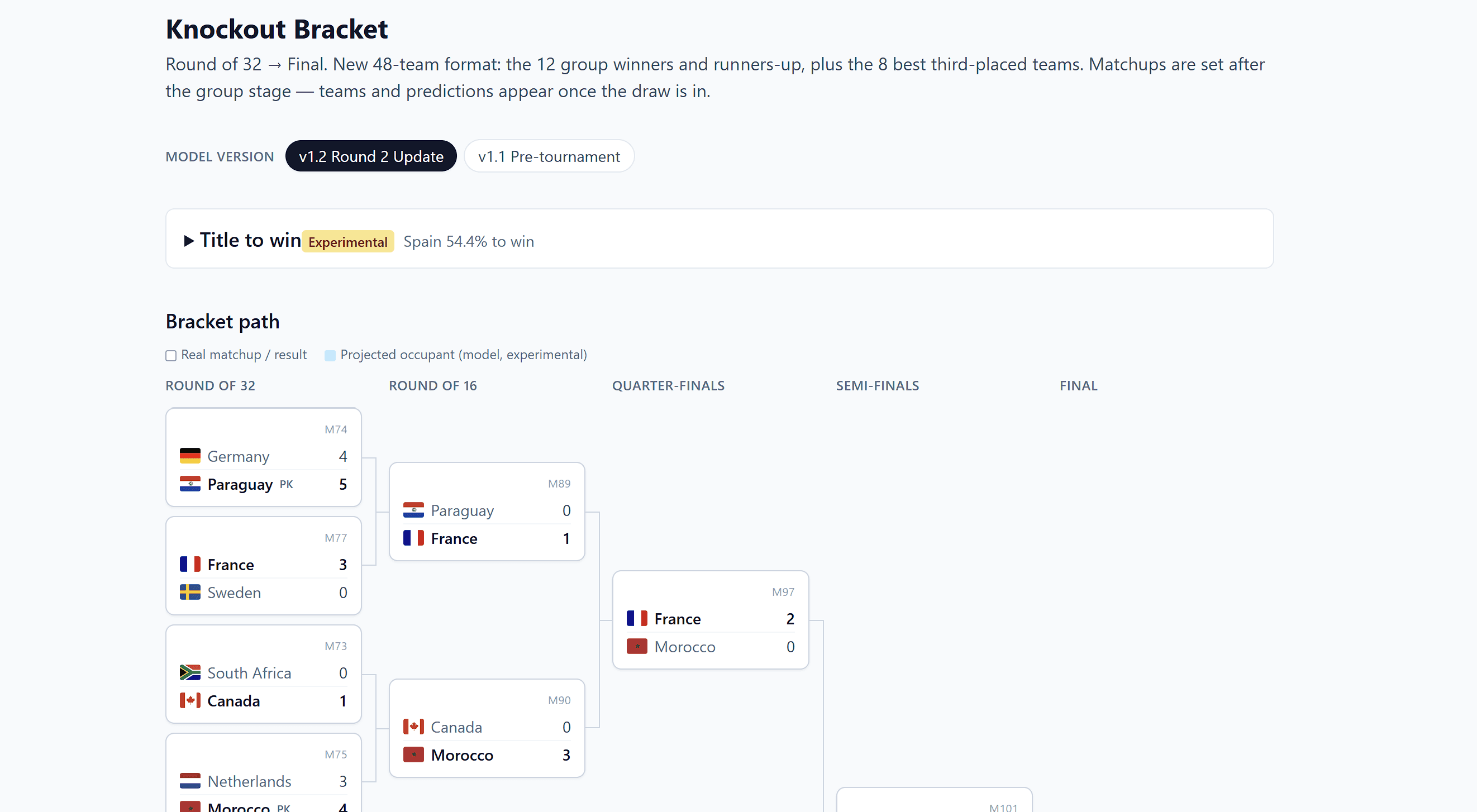
Seventy-two group-stage matches were forecast before a ball was kicked, each benchmarked against the market, with full-tournament champion and advancement odds from the Monte Carlo layer and a live knockout bracket.
The engine is pure-function Python with a fail-loud, idempotent ETL that raises on an unmatched team name rather than guessing. The value maths was written once in Python and ported to TypeScript, with the two locked together by golden vectors: 84 passing tests keep the client and the reference implementation in sync. The site is bilingual (Traditional Chinese and English) and carries the required Elo attribution (CC BY-SA 4.0) and market-efficiency disclaimers throughout.
Accountability is built into the product, not just the process. A track-record page pins the frozen pre-tournament predictions against actual results and scores them (hit rate and Brier score) beside the market, so the model's honesty is checkable rather than asserted. A divergence view surfaces the matches where model and market disagree most, and states plainly next to each one that a big divergence usually means the model is the one that's wrong.
Stack & links
Next.js (App Router) · Tailwind · next-intl · Supabase Postgres ·
Python (Dixon-Coles engine, Monte Carlo) · GitHub Actions · Vercel